







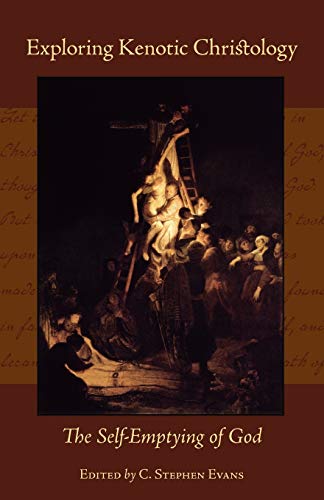
Exploring Kenotic Christology: The Self-Emptying of God
University Professor of Philosophy and Humanities and Professorial Fellow C Stephen Evans PhD
Regent College Publishing, 2009
360 pp., 36.95

John G. Stackhouse, Jr.
A Christ We Can Follow
The new kenotic theologyOrthodox Christians affirm the basic Christological parameters set out at the Council of Chalcedon in AD 451: Jesus was truly divine and truly human, one person in two natures. Such Christians also affirm that no one can comprehend just how the Second Person of the Trinity became human. Recent theology, however, has returned to the category of kenosis to see if it can render at least a little more coherent this paradox of the Incarnation, and a fine sampling of this new conversation can be found in the essays collected by philosopher C. Stephen Evans in Exploring Kenotic Christology: The Self-Emptying of God.
The paradox has long delighted preachers and poets, even as it has vexed theologians. How can the Logos sleep as an infant in his mother's arms? How can the Son who is co-eternal with the Father and in whom "all the fullness of the Godhead dwells" (Col. 2:9) possibly "grow in wisdom" (Luke 2:52)? How can the light of the world who enlightens everyone (John 1:9) not know some things (Mark 13:32)? How can he who created and sustains the cosmos and who brings eternal life to the world somehow suffer, die, and be buried, as the Apostles' Creed declares?
The traditional Christian answer is that the Son of God took on humanity, adding to his divinity the reality of human being. In some way we do not understand, the respective traits and experiences of Christ's divinity and humanity were shared in his single person, what is known theologically as the communicatio idiomatum.
Several related problems have always been implied by this rendering of the Incarnation. These problems have been addressed by kenotic theology, which is best known (and stigmatized) as a 19th-century movement in Germany and then Britain that erred too far on the "human" side of the Chalcedonian affirmation. (Thomas Thompson provides a full account of this story as part of his participation in this book.) But philosophers and theologians today (notably contributors Stephen Davis and Ronald Feenstra) are revisiting that approach to Christology with full appreciation for the difficulties attending the work of their forebears.
The first problem afflicting traditional Christology is a textual one. (Gordon Fee and Bruce Fisk lay out exegetical considerations well in this book.) The Bible itself says that Christ emptied himself—from which word's Greek root we derive kenosis (Phil. 2:7). That passage, however, is not obviously clear as to what "emptying" means. Other passages sharpen the issue, as they speak of Jesus "growing in wisdom and stature" and not knowing the time of the end (Luke 2:52; Mark 13:32). Another passage says that Jesus learned obedience through suffering—two mysteries in a single phrase (Heb. 5:8)! So Christians who take their theological cues particularly from the Bible should be willing to consider these verses as implying that not only did God add to himself humanity, but also in some way subtracted something from himself in order to do so.
The second problem is a theologico-philosophical one. The event of the Incarnation seems to be an obvious change in the life of God—indeed, the most drastic change we can see in Scripture. It also is an event fraught with suffering. Therefore, the traditional presuppositions that God is both immutable and impassible must be revised, and kenotic theory helps us do that.
This new kenotic theology suggests that God the Son somehow (we don't know how) freely relinquished his powers as an equal member of the Trinity, handing them over to the Father and the Spirit, as it were (most of what follows is "as it were"!), to undergo a genuinely human experience of limitation and consequent dependence—on God, yes, and on his parents, his society, and the planet, just as we also must depend on this matrix of life. He really did learn as we learn, eventually coming to awareness of his divine-human identity and role—doubtless through his parents' recollections of angelic testimony, the teaching of the Torah available in Nazareth, his own precocious learning of it (Luke 2:49), and likely direct revelations, all of which were guided by the Holy Spirit. (Thus kenotic Christology dovetails with the recent emphasis in New Testament scholarship on a "Jewish Jesus.")
When Jesus entered his public ministry, therefore, he did so with awareness of who he was and what he was to do, while depending all along on the Father and the Spirit, as we must do, rather than exerting his own divine powers on his own. To use the striking metaphor of Marilyn McCord Adams, Jesus went through his life without using a "divine powerpack," but instead restricted himself to the "human powerpack" available to anyone who is totally yielded to God—which is, indeed, to live fully in the light of the Kingdom of God in the power of the Spirit, as Jesus did.
The final problem is a theologico-practical one—and one not fully dealt with in the Evans volume, which understandably focuses more on the ontological issues. But here is another instance of where praxis and theoria engage helpfully in dialogue. If Jesus didn't experience life as a human being in the same way that we do—most significantly, if he did not live as a truly limited human being who trusted and obeyed God the Father (John 5:19) and who depended on and was led by God the Holy Spirit (Mark 1:12)—then some huge implications follow. Let's examine two.
First, Jesus cannot serve as an example to us. So much for imitatio Christi. For what can we possibly learn about how to live a life of obedience to God, of dependence upon God, and of cooperation with God from a God-man who switches on his divine powerpack whenever he needs to negotiate a difficult situation? To truly serve as an example to us, Jesus has to be like us, seeking to do the will of his Father in heaven and relying moment by moment on the leading and empowering of the Holy Spirit. Indeed, it is precisely because he did live this way, so kenotic theologians aver, that he can promise that we will do "greater works than these" because he is going away and the Father will send the Spirit now to us—the implication being that the Father will do so as he gave the Spirit to Jesus (John 14:10, 12, 17; 16:7-15).
Second, Jesus cannot represent us as our sympathetic advocate. So much for his high priestly ministry, detailed in the book of Hebrews. Indeed, a key qualification for this great work—begun as he offered himself as sacrifice, yes, but continuing in the presence of God where "he ever lives, making intercession for us" (Heb. 7:25) in a glorious picture of the enduring love of the triune God for the humanity he has saved at his own great cost—is that "he was tempted in every respect as we are, yet without sin." But how can God possibly be tempted, even if he somehow joins humanity to himself, if he retains his divine powers? Kenotic Christology helps here as well, for in positing a Jesus who could not simply "turn on" his divinity like a lamp to banish sin, this theology upholds a truly useful example for us of a man who did not yield, ever, to sin as he prayed, recalled Scripture, and otherwise resisted temptation. (Whether Jesus could have sinned is not at issue. For it is doubly impossible: according to his divine nature, yes, but also according to the holy human character he had, such that he could no more sin than a loving mother could cheerfully torture her child.)
Let's make this point more clear. In any temptation, we ourselves each have a particular "breaking point," according to our particular character, below which we will not yield to temptation. We don't know what that breaking point might be, however. So whenever we undergo temptation, it certainly feels challenging to us, whether minor or major, and the more so as it approaches our breaking point. And our response to that temptation shows our true character. It is, as the Bible says it is in the ambiguity of the word ("temptation" = "trial" = "testing"), a "trying experience" that both demonstrates and confirms our character. In the case of the temptation of Jesus, for such an experience to connect with our own experience of temptation all that has to happen is for Jesus to undergo it without knowing already that he will successfully resist anything that comes his way. Even if he did somehow know he would endure, moreover, that doesn't make the attraction of the temptations any less. Indeed, Jesus is our supreme example precisely because he seems to have been too holy to be seriously distracted by the minor-league stuff that trips up you and me. No, for Satan to get to him, he had to use the biggest issues, whether the matter of life and death (create bread out of a stone while starving), global power (all the kingdoms of the world), or the authenticity of his identity and calling (make God save you). Thus Jesus experienced genuine temptation, and thus he provides a genuine example to follow.
Objections to kenotic Christology immediately spring to mind, of course. Here are several of them. First, what happens to the universe with the divine Logos temporarily out of office? Nothing bad: the Father and the Spirit handle things quite competently. God has not divested himself entirely of his great attributes and responsibilities. One member of the Trinity has done so, temporarily, in order to fulfill this crucial stage of the mission of God.
Second, if God is omnipotent by definition, how can he be less than omnipotent as Jesus Christ and still be divine? Kenoticists answer that God is better defined as the Bible seems to define God: as possessing even the power for one member of the Trinity to temporarily relinquish his divine abilities in order to accomplish the great good of salvation—while the triune God never ceases being omnipotent as Father and Spirit. (Some theologians, such as Cornelius Plantinga and Thompson in this volume, thus push strongly in the direction of "social trinitarianism," but one need not go as far as they do to hold to this view of the Incarnation. One merely has to believe, as Nicea says, in one God in three persons.)
Third, how can we account for the miracles that Christ performed? Were there addenda to the kenotic contract allowing him to turn on his powerpack now and then for particular purposes? The most honest response from advocates of kenotic Christology is to admit that this is a problem, adamantly refusing to try and explain the miracles away—and noting, once again, that any understanding of the Incarnation which takes the biblical witness seriously must acknowledge that the reality of this event exceeds our understanding.
Fourth, how can God change and even suffer? Critics of kenotic Christology might insist that kenotic Christology is incompatible with the affirmation of Chalcedon that God is "immutable" or "unchangeable." But that's not what Chalcedon actually says.
In its characteristic attempt at even-handedness—either to speak in parallel clauses or to say the same things about Christ's divinity and Christ's humanity—the Chalcedonian definition says that the two natures in Christ are "without confusion, without change, without division, without separation." Note that Chalcedon applies these adjectives to both natures in Christ, the human as well as the divine.
Human beings undergo change all the time. So Chalcedon cannot be read as endorsing what we might call the "comprehensive immutability" of human beings, the idea that human beings never change in any respect. It therefore cannot be read as endorsing the "comprehensive immutability" of God, either. Instead, Chalcedon is saying that whatever is immutable about both divine and human nature stays the same in Christ so that he is always truly divine and truly human. And kenotic Christology stoutly affirms that teaching: Christ is no less divine for the Son of God having emptied himself of whatever he did in order to become also truly human. In Christ, God underwent change but with no loss to his essential divinity, just as Christ as a human being clearly underwent change but with no loss to his essential humanity.
This last point leads us to a fundamental matter of theological method. Kenotic Christology does challenge orthodox assumptions—indeed, the assumptions of most, if not all, of the framers of the Chalcedonian Definition themselves, who generally did believe in the immutability of God and therefore struggled mightily to accommodate that belief to the facts of the Incarnation. (How do I square that observation with the wording of Chalcedon that seems, as I have argued, to leave the door open to kenotic Christology? I frankly think that, under the guidance of the Holy Spirit, the fathers wrote better than they knew.) How such assumptions did and should function in theology now comes to the fore.
Many of us Protestants, and particularly those of us who call ourselves evangelicals, are not used to thinking that philosophical assumptions play any important part in our theology. Sure, we can spot particular philosophies readily enough in the work of the early apologists of the church, or in Augustine, or in the medieval theologians. We also see philosophy playing a role—usually a deleterious one—in the work of unorthodox theologians, whether Schleiermacher or Hartshorne or Tillich. But serious consideration of kenotic Christology shows us that we, too, necessarily think theologically in the grip of philosophical assumptions.
Yes, each of us is shaped by one or another particular philosophical outlook. But there is a much more fundamental point to be observed here. All of us Christians, no matter our particular philosophical formation, reflexively engage in a particular philosophical mode when we are constructing the doctrine of God and, in this case, the doctrine of Christ. It is not enough, that is, to feel free to disagree with this or that aspect of classical theology on the basis that the church at that time was influenced by a Hellenism we no longer inhabit. We are nonetheless linked to our ancient forebears by the reflex toward what we might call "perfect being philosophy": a reasoning toward how God must be on the basis of what we assume to be the greatest possible predicates we can furnish for God.
Two particular attributes of God therefore are discussed in this conversation as if we all agree how God must be—and how, therefore, Christ must be, since "God was in Christ." We all are supposed to agree that since God is perfect then God does not change and God has all power. Chalcedon affirms that Christ is fully divine. So he also must never change and must have all power. Chalcedon also, however, affirms that Christ is fully human. Humans change and humans do not have all power. So what is to be done with this apparent contradiction? Traditional Christology, it seems, has leaned hard toward the divine side, while kenotic Christology is pushing hard toward the human side. Pushing too far in this latter direction is what got kenotic Christology into trouble in the 19th century, and today's exponents of this theology are trying hard not to repeat that mistake. But they are also trying to extricate Christology from assumptions about a "perfect being" that not all of us feel obliged to share today.
In particular, kenotic Christology says that the doctrine of divine immutability, and its correlate, divine impassibility, are simply wrong in the light of the Christ event as witnessed in Scripture. The Bible is much better read as depicting a change in the life of God, namely, the Incarnation, and as depicting suffering in the life of God, namely, the Cross. Whatever else we might think about God, the revelation of God in Christ as recorded in Scripture seems clearly to show that God can change and God can suffer. Kenotic Christology, that is, privileges the biblical story of Jesus above our assumptions about God drawn from perfect being philosophy.
Kenotic Christology, furthermore, goes on to say that, while God the Father and God the Holy Spirit continue to manifest fully all of the divine attributes, God the Son lays aside enough of his normal mode of life as God to experience life truly as a human being. In particular, he is able to lay aside some of his power without laying aside his divine nature. Perfect being philosophy would see such a contention as flatly contradictory and therefore not true: the Son of God can't become Jesus and give up any of the divine attributes. Well, say kenotic Christologists, if one judges the matter from the Scriptural testimony regarding the life of Christ, apparently he can.
I myself have been working along kenotic lines for some time in my thinking and teaching about Jesus. As I've done so, I've come across a least one aspect of the problem not addressed in this volume that might prove suggestive for others continuing in this vein. This aspect has to do with the distinction between the noumenal and the phenomenal—or, to use more straightforward terms, the difference between Christ's own being and Christ's experience. When the Second Person of the Trinity "emptied himself" to share in our humanity, did he in fact lay aside some of his divine attributes or did he instead lay aside his omniscience and with that "self-emptying" also give up his consciousness of some of those attributes such that his experience of human life squares with ours? (No, I have no idea of what it means to voluntarily give up omniscience! Kenosis doesn't solve every theological problem here, that's for sure.)
It may help the metaphysics of the situation to see the kenosis of Jesus as involving only his consciousness rather than his actual being—thus preserving Chalcedon's affirmation of "truly God and truly man." And as long as Jesus went through his life experiencing the world as we do and living in it as we must try to do also, then he can function fully as our example—while we theologians avoid some of the metaphysical oddities that attend at least some kenotic construals of what happened to the Second Person of the Trinity in the event of the Incarnation.
Indeed, this way of looking at things might help us with one of the most difficult aspects of Christology in the light of the doctrine of the Trinity, namely, Jesus' cry of dereliction from the cross. How does it make sense to believe that there was some kind of ontic rupture in the Trinity between God the Son and the other two members of the Godhead? Such a (common) speculation is not necessary. All that is necessary is to believe that the Son of God, representing us sinners as the Son of Man, went through an experience of dereliction.
(I myself am inclined to a quite different interpretation of Jesus' reference to Psalm 22 on the cross. I think his quotation of the opening of that psalm is meant to trigger recollection of the entire psalm in the minds of his hearers. And that song speaks of David's suffering as one who is ultimately vindicated by God—not, in fact, deserted by him. But I will merely register this alternative here in the name of full disclosure, while noting the kenotic alternative as one more in line with the longstanding tradition of viewing Jesus as actually experiencing dereliction.)
For Christians, therefore, who prize the Bible as divine revelation and who therefore pore over its details in search of further light that might yet break forth from God's Holy Word, kenotic Christology deserves a serious look. Yes, it challenges our assumptions. But it might help us draw closer in theory and in practice to the One whom to follow is eternal life.
John G. Stackhouse, Jr., is Sangwoo Youtong Chee Professor of Theology and Culture at Regent College in Vancouver, Canada. He is the author most recently of Making the Best of It: Following Christ in the Real World (Oxford Univ. Press).
Copyright © 2011 by the author or Christianity Today/Books & Culture magazine.
Click here for reprint information on Books & Culture.
 Email Newsletter
No comments
See all comments
*